Regulations
Is Plug-In Solar Legal in Northern Ireland?
Is plug-in solar legal in Northern Ireland? Learn why the new Great Britain rules do not currently apply, how NI differs and what to check before buying.
3 Oct 2026 · 10 min read
Compare. Calculate. Plug into solar.
Compare plug-in solar panels in the UK, estimate your potential savings and understand what you need before buying.
Plug-in solar is not suitable for every property. Positioning, mounting, electrical condition, permissions, fire safety and insurance all need to be considered before you buy.
Start here
Answer five questions for a preliminary view on whether a plug-in system is worth considering at your property, or whether a full roof installation makes more sense.
Five questions, no email required.
Comparison
Recorded specifications, prices and compliance status for the kits currently in our database.
The catalogue currently contains demonstration records. Prices, ratings and compliance values are placeholders until verified entries are added.
No products match your filters.
Savings
Enter three quick details for an immediate estimated range, then open the full calculator for scenarios, payback and a transparent breakdown.
Estimated annual saving
£79 – £114
Estimate only, based on a south-facing position with light shading and a 26p/kWh tariff. Your result will differ.
Get My Full EstimateHow it works
Plug-in solar is simple in principle, but the detail matters — especially the electrical and mounting side.
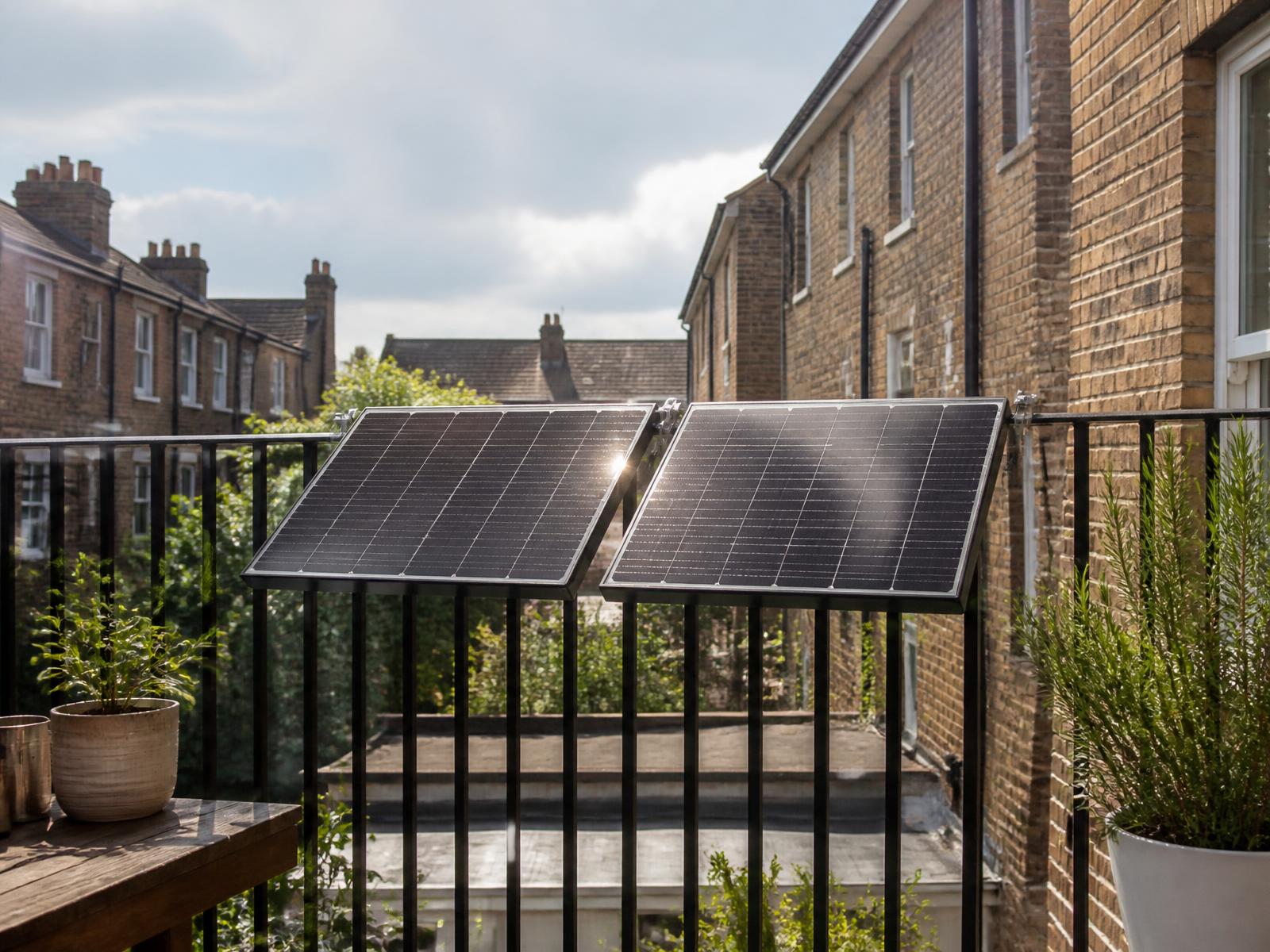
One or two panels on a balcony, wall, frame or outbuilding convert daylight into direct current.
The microinverter turns that direct current into alternating current at mains voltage and frequency.
The system connects through the approved arrangement supplied with a compliant product. Follow the manufacturer's documentation and check your electrical installation is in good condition.
Appliances that are running draw the available solar electricity before the same amount is taken from the grid, so your metered import falls.
Suitability
It is a good fit for some households and a poor fit for others. Here's where it tends to work.
Portable systems can move with you, but you will normally need your landlord's written agreement first.
A balcony railing can work well, subject to your lease, building rules and safe fixing.
A low-cost way to see how much daytime electricity you can genuinely displace.
Shaded, north-facing, listed or structurally awkward roofs may rule out a full installation.
The more you use while the sun is up, the more of the generation you actually save on.
Freestanding and ground-mounted kits can be repositioned or taken with you when you move.
Honest comparison
Plug-in solar is a small, low-cost system. It is not a replacement for a full roof installation.
| Factor | Plug-in solar | Rooftop solar |
|---|---|---|
| Typical starting cost | From around £450 | Usually several thousand pounds |
| Maximum system size | Up to 800W in Great Britain | Limited mainly by roof area |
| Installation complexity | Usually self-set-up following the supplied documentation | Professional installation required |
| Portability | Often portable | Permanent |
| Potential generation | Modest — a few hundred kWh a year | Typically several thousand kWh a year |
| Export potential | Generally not intended for export | Export tariffs usually available |
| Suitability | Balconies, gardens, walls, outbuildings | Suitable, unshaded roof space |
| Permissions | Landlord, freeholder or building rules may apply | Installer handles notification; planning may apply |
| Best use case | Cutting daytime baseload cheaply | Covering a large share of household use |
If a plug-in system won't cover enough of your usage, a full installation may be the better option.
Guides
Practical, UK-specific explanations of the rules, the costs and the checks.
Regulations
Is plug-in solar legal in Northern Ireland? Learn why the new Great Britain rules do not currently apply, how NI differs and what to check before buying.
3 Oct 2026 · 10 min read
Regulations
Can plug-in solar use a normal UK socket? Learn the socket, RCD, outdoor connection and extension-lead requirements before installing a system.
3 Oct 2026 · 11 min read
Regulations
Does plug-in solar work with a smart meter? Learn how solar affects import and export readings, what your display may show, and what matters for SEG payments.
3 Oct 2026 · 10 min read
Regulations
What happens when plug-in solar produces more electricity than your home is using? Learn where surplus power goes and whether you can be paid for exporting it.
3 Oct 2026 · 9 min read
Regulations
Whether you can pair a battery with plug-in solar in the UK: what the current rules cover, why batteries sit outside the simplified framework, and what to check before buying.
3 Oct 2026 · 8 min read
Regulations
When and how to notify your Distribution Network Operator about plug-in solar in Great Britain, including G98, the 28-day connect-and-notify process, and what information you may need.
5 Sept 2026 · 9 min read
Newsletter
Receive new product alerts, price changes, regulation updates and practical buying guidance.